A hi-tech wood-fired stove
A wood-fired stove may be past, but it is still used in rural areas of under developed and developing countries like India. But, when British scientist had a relook at it, from advanced technical aspect, a revolutionary wood-fired stove powered by soundwaves is developed under the SCORE (Stove for Cooking, Refrigeration and Electricity) project, to both cook and cool food. The innovation that could help millions in poor countries with scant electricity or near lack of electricity.
According to Reuters, the all-in-one cooker, refrigerator and generator will use thermo acoustic technology - a hi-tech and more efficient way of harnessing the energy in wood than an open fire.
It works like this. The "super-stove" will channel heat into a special pipe to produce pockets of high and low gas pressure, generating sound in a similar way to a singing kettle. An alternator then converts the sound into electricity to power the appliance.
The SCORE (Stove for Cooking, Refrigeration and Electricity) project director Paul Riley aims to make it commercially available on a pilot basis within four years.
He says "We are hoping to build a million a year after year five - that's the aspiration - and the price target we've set ourselves is between 15 and 20 pounds ($30-40) per unit,".
Showing posts with label Breakthroughs. Show all posts
Showing posts with label Breakthroughs. Show all posts
Tuesday, June 19, 2007


Monday, April 02, 2007
Wireless electricity transmission
It is difficult to believe but wireless electricity will be reality very soon. Powercast, a US based startup along with more than 100 companies (of which Philips is one of the major partner) are set to launch their first device powered by electricity broadcast through the air.
The basic idea works like this. A transmitter plugs into the wall, and a dime-size receiver costing about $5 to make can be embedded into any low-voltage device. The receiver turns radio waves into DC electricity, recharging the device's battery at a distance of up to 3 feet.
Powercast says it has signed nondisclosure agreements to develop products with more than 100 companies, including major manufacturers of cell phones, MP3 players, automotive parts, temperature sensors, hearing aids, and medical implants.
It is difficult to believe but wireless electricity will be reality very soon. Powercast, a US based startup along with more than 100 companies (of which Philips is one of the major partner) are set to launch their first device powered by electricity broadcast through the air.
The basic idea works like this. A transmitter plugs into the wall, and a dime-size receiver costing about $5 to make can be embedded into any low-voltage device. The receiver turns radio waves into DC electricity, recharging the device's battery at a distance of up to 3 feet.
Powercast says it has signed nondisclosure agreements to develop products with more than 100 companies, including major manufacturers of cell phones, MP3 players, automotive parts, temperature sensors, hearing aids, and medical implants.
Tuesday, January 30, 2007
Genetically modified chickens to produce life saving protein in eggs.
UK scientists have produced genetically designer eggs with protein to fight cancers. This breakthrough has been achieved by the same research center who created cloned sheep 'Dolly'. These eggs are layed by genetically modified chickens, running in to fifth generations now.
Some of the birds have been engineered to lay eggs that contain miR24, a type of antibody with potential for treating malignant melanoma, a form of skin cancer. Others produce human interferon b-1a, which can be used to stop viruses replicating in cells.
The proteins are secreted into the whites of the eggs. It is a fairly straightforward process then to extract and purify them.
UK scientists have produced genetically designer eggs with protein to fight cancers. This breakthrough has been achieved by the same research center who created cloned sheep 'Dolly'. These eggs are layed by genetically modified chickens, running in to fifth generations now.
Some of the birds have been engineered to lay eggs that contain miR24, a type of antibody with potential for treating malignant melanoma, a form of skin cancer. Others produce human interferon b-1a, which can be used to stop viruses replicating in cells.
The proteins are secreted into the whites of the eggs. It is a fairly straightforward process then to extract and purify them.
Friday, November 24, 2006
Chip to Convert Hit to Electricity
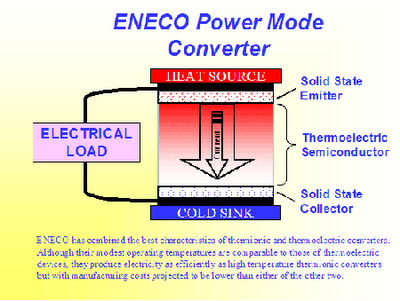
Speaking in a hotel conference room near Tower Bridge late last week Dr Lew Brown, president and CEO of Eneco, is trying to convince a roomful of sceptical investors that its new chip technology will revolutionise the way we generate electricity. It has to be said that he is doing a pretty good job.
"This chip compares with the invention of the transistor, or the TV, or the first aircraft," he says. "It is a genuinely disruptive technology." Now if a claim like that won’t get investors' attention I'm not sure what will.
As reported last week, Eneco is a development stage company that claims to have invented and patented a "solid state energy conversion/generation chip" that will convert heat directly into electricity or alternatively refrigerate down to -200 degrees celsius when electricity is applied.
As one potential investor who has flown all the way from Scotland for the two hour presentation confides: "I had to come, it just sounded too good to be true."
He is not alone, interested parties have also traveled from Italy, Switzerland, Ireland and all over the UK to see if the miracle chip might deliver on its promises.
So is it too good to be true? Will it work?
Well, on first impressions it just might. And it could have a massive impact on how IT equipment, and in particular laptops and other mobile devices, are designed and powered.
The chip is based on the principles of thermionic energy conversion whereby the energy of a hot metal over comes the electrostatic forces holding electrons to its surface. These free electrons then pass across a vacuum to a cold metal and in the process create an electronic charge that can be harnessed.
The main difficulty with exploiting this process at a commercial level has been in creating the vacuum between the two metals. But Eneco has overcome the problem by replacing the vacuum with, what the brochure describes as, "a properly selected semiconductor thermoelectric that is thick enough to support a significant temperature differential between the emitter and the collector in order to achieve efficiencies of practical interest".
The result is a solid state energy conversion chip that can operate at temperatures of up to 600 degrees celcius and deliver absolute efficiencies in terms of how much heat energy is converted to electricity of between 20 and 30 percent.
If the energy conversion rate is impressive the potential list of practical applications proves equally exciting.
Initially Eneco plans to target the "low-hanging fruits" found in the existing thermoelectric market. The company says the technology would suit off-grid energy generation environments, such as pipeline monitoring stations and space craft, where its promises to outperform existing thermoelectric products. The company also expects to have its first order in this area from the US military soon.
The next potential market for Eneco lies in portable power, where it hopes the chips will ultimately replace high end lithium ion and polymer batteries used in laptops and other handheld devices.
The company says it is already in talks with both Dell and Apple about how the chips could be used in their devices. Initial talks have focused on integrating the heat conversion chips into the device so it can harness the heat generated by processors and turn it into electricity to power fans or other cooling technologies. By harnessing this power the devices, be they initially laptops and handhelds, or later even servers and PCs, should see improved energy efficiency, extended battery life and enhanced performance.
Brown also sees the chips ultimately replacing batteries altogether. He argues that by linking the modules to a microburner - a catalytic burner that produces between 275 and 600 degrees centigrade – you can heat the chips and generate enough power to run the device.
In theory this approach would be far cleaner as the burners that Eneco is planning to employ use Ethanol – a biofuel that is carbon neutral as the CO2 emitted when it burns is consumed as the original plant grows.
It is also more convenient than current battery systems, according to Brown, as it would prove lighter, less bulky, quieter and would not need recharging as "when the burner runs out you can instantly replace it by putting in a new fuel cassette".
The handheld device market represents a $5bn opportunity according to Eneco, but the real cash cow for the company appears will come from harnessing waste heat and turning it into power.
Currently we spend around $1,500bn a year globally on fossil fuels, but when they are burned around 50 percent of the energy is wasted. Eneco envisages a situation where integrating its chips onto the side of a furnace for example would help capture much of that wasted heat and turn it into useful energy.
This situation could be mirrored in any number of industrial environments where heat is created while on a smaller scale the chips could also replace alternators in cars.
Eneco claims all these scenarios are plausible even before you consider the chip's ability to act as a cheap and efficient cooling technology potentially deployed in air conditioning, refrigeration units, and, of course, IT equipment.
These theoretical deployments are all well and good but the big issue for investors is whether the technology works and how close Eneco is to realising these many applications. And, in fairness to Brown he has an answer to almost every question from the floor.
In response to questions about their durability he claims that current thermoelectric technologies used on NASA's spacecraft have a life of over twenty years with no degradation in performance and that the chips are expected to enjoy a similar lifespan. Meanwhile, the fact that there are no moving parts means there is no wear and therefore no maintenance requirements.
Questions about how easy it is to manufacture the chips are also batted away with Brown claiming it can be built using established microprocessor design practices, while he is equally adamant that 48 patents or patents pending mean there is no danger of the technology "being stolen from under us".
The main technical concern from the floor is around how you keep a temperature differential between two sides of a chip no thicker than a coin. But speaking to GBN after the presentation Brown explains that the design of modules incorporating multiple chips will resolve this issue.
"Within the module you have a top ceramic plate which makes heat distribution uniform, then you have the chips in between and another ceramic plate on the bottom that takes the heat away," he says. "These ceramic plates effectively act as insulation so the hot side will be significantly hotter than the cold side."
In theory this means you can stick the module on the side of a boiler, for example, and the external or cold side will still be very hot, but it'll be sufficiently cold compared to the side actually in contact with the boiler that there is a differential capable of generating a significant amount of electricity.
This makes sense but it does strike that the key issue for the chip when used practically will be in ensuring the insulation is good enough to make this differential sufficiently large so that enough energy is produced to make the deployment worthwhile.
So where is the fly in the ointment? Well, Brown does admit there are "issues" with the packaging. The chips are so small that packaging them together in a module is tricky and the focus of the development effort is currently in this area.
Eneco insists it is making good progress and its first products will be available by the end of next year or early 2008, but while this may be perfectly feasible in the thermoelectric market where the applications will be relatively simple getting the chips into other environments may prove trickier.
Talks with potential customers about how exactly the technology should be used are only at an early stage and even though firms such as Apple, Dell, Ford, BMW and Boeing are all interested there appear to be plenty of issues to iron out.
"We are talking to partners about what they need to do and what we need to do to get the first demonstration products built," admits Brown. "For example, we're not there yet [with Dell and Apple] on where [the chip will] sit on the motherboard. Though it is so small it could also be incorporated as part of the processor."
The lack of clarity on such fundamental design issues suggests it is likely to be some time before Eneco powered devices emerge. But if these issues can be overcome - and anyone with any experience of energy conversion technologies will tell you it remains a big if - the company does appear to have a truly disruptive technology that could deliver clean, cheap and efficient power to a raft of different industries.

Speaking in a hotel conference room near Tower Bridge late last week Dr Lew Brown, president and CEO of Eneco, is trying to convince a roomful of sceptical investors that its new chip technology will revolutionise the way we generate electricity. It has to be said that he is doing a pretty good job.
"This chip compares with the invention of the transistor, or the TV, or the first aircraft," he says. "It is a genuinely disruptive technology." Now if a claim like that won’t get investors' attention I'm not sure what will.
As reported last week, Eneco is a development stage company that claims to have invented and patented a "solid state energy conversion/generation chip" that will convert heat directly into electricity or alternatively refrigerate down to -200 degrees celsius when electricity is applied.
As one potential investor who has flown all the way from Scotland for the two hour presentation confides: "I had to come, it just sounded too good to be true."
He is not alone, interested parties have also traveled from Italy, Switzerland, Ireland and all over the UK to see if the miracle chip might deliver on its promises.
So is it too good to be true? Will it work?
Well, on first impressions it just might. And it could have a massive impact on how IT equipment, and in particular laptops and other mobile devices, are designed and powered.
The chip is based on the principles of thermionic energy conversion whereby the energy of a hot metal over comes the electrostatic forces holding electrons to its surface. These free electrons then pass across a vacuum to a cold metal and in the process create an electronic charge that can be harnessed.
The main difficulty with exploiting this process at a commercial level has been in creating the vacuum between the two metals. But Eneco has overcome the problem by replacing the vacuum with, what the brochure describes as, "a properly selected semiconductor thermoelectric that is thick enough to support a significant temperature differential between the emitter and the collector in order to achieve efficiencies of practical interest".
The result is a solid state energy conversion chip that can operate at temperatures of up to 600 degrees celcius and deliver absolute efficiencies in terms of how much heat energy is converted to electricity of between 20 and 30 percent.
If the energy conversion rate is impressive the potential list of practical applications proves equally exciting.
Initially Eneco plans to target the "low-hanging fruits" found in the existing thermoelectric market. The company says the technology would suit off-grid energy generation environments, such as pipeline monitoring stations and space craft, where its promises to outperform existing thermoelectric products. The company also expects to have its first order in this area from the US military soon.
The next potential market for Eneco lies in portable power, where it hopes the chips will ultimately replace high end lithium ion and polymer batteries used in laptops and other handheld devices.
The company says it is already in talks with both Dell and Apple about how the chips could be used in their devices. Initial talks have focused on integrating the heat conversion chips into the device so it can harness the heat generated by processors and turn it into electricity to power fans or other cooling technologies. By harnessing this power the devices, be they initially laptops and handhelds, or later even servers and PCs, should see improved energy efficiency, extended battery life and enhanced performance.
Brown also sees the chips ultimately replacing batteries altogether. He argues that by linking the modules to a microburner - a catalytic burner that produces between 275 and 600 degrees centigrade – you can heat the chips and generate enough power to run the device.
In theory this approach would be far cleaner as the burners that Eneco is planning to employ use Ethanol – a biofuel that is carbon neutral as the CO2 emitted when it burns is consumed as the original plant grows.
It is also more convenient than current battery systems, according to Brown, as it would prove lighter, less bulky, quieter and would not need recharging as "when the burner runs out you can instantly replace it by putting in a new fuel cassette".
The handheld device market represents a $5bn opportunity according to Eneco, but the real cash cow for the company appears will come from harnessing waste heat and turning it into power.
Currently we spend around $1,500bn a year globally on fossil fuels, but when they are burned around 50 percent of the energy is wasted. Eneco envisages a situation where integrating its chips onto the side of a furnace for example would help capture much of that wasted heat and turn it into useful energy.
This situation could be mirrored in any number of industrial environments where heat is created while on a smaller scale the chips could also replace alternators in cars.
Eneco claims all these scenarios are plausible even before you consider the chip's ability to act as a cheap and efficient cooling technology potentially deployed in air conditioning, refrigeration units, and, of course, IT equipment.
These theoretical deployments are all well and good but the big issue for investors is whether the technology works and how close Eneco is to realising these many applications. And, in fairness to Brown he has an answer to almost every question from the floor.
In response to questions about their durability he claims that current thermoelectric technologies used on NASA's spacecraft have a life of over twenty years with no degradation in performance and that the chips are expected to enjoy a similar lifespan. Meanwhile, the fact that there are no moving parts means there is no wear and therefore no maintenance requirements.
Questions about how easy it is to manufacture the chips are also batted away with Brown claiming it can be built using established microprocessor design practices, while he is equally adamant that 48 patents or patents pending mean there is no danger of the technology "being stolen from under us".
The main technical concern from the floor is around how you keep a temperature differential between two sides of a chip no thicker than a coin. But speaking to GBN after the presentation Brown explains that the design of modules incorporating multiple chips will resolve this issue.
"Within the module you have a top ceramic plate which makes heat distribution uniform, then you have the chips in between and another ceramic plate on the bottom that takes the heat away," he says. "These ceramic plates effectively act as insulation so the hot side will be significantly hotter than the cold side."
In theory this means you can stick the module on the side of a boiler, for example, and the external or cold side will still be very hot, but it'll be sufficiently cold compared to the side actually in contact with the boiler that there is a differential capable of generating a significant amount of electricity.
This makes sense but it does strike that the key issue for the chip when used practically will be in ensuring the insulation is good enough to make this differential sufficiently large so that enough energy is produced to make the deployment worthwhile.
So where is the fly in the ointment? Well, Brown does admit there are "issues" with the packaging. The chips are so small that packaging them together in a module is tricky and the focus of the development effort is currently in this area.
Eneco insists it is making good progress and its first products will be available by the end of next year or early 2008, but while this may be perfectly feasible in the thermoelectric market where the applications will be relatively simple getting the chips into other environments may prove trickier.
Talks with potential customers about how exactly the technology should be used are only at an early stage and even though firms such as Apple, Dell, Ford, BMW and Boeing are all interested there appear to be plenty of issues to iron out.
"We are talking to partners about what they need to do and what we need to do to get the first demonstration products built," admits Brown. "For example, we're not there yet [with Dell and Apple] on where [the chip will] sit on the motherboard. Though it is so small it could also be incorporated as part of the processor."
The lack of clarity on such fundamental design issues suggests it is likely to be some time before Eneco powered devices emerge. But if these issues can be overcome - and anyone with any experience of energy conversion technologies will tell you it remains a big if - the company does appear to have a truly disruptive technology that could deliver clean, cheap and efficient power to a raft of different industries.
Wednesday, November 15, 2006
Wireless Power
The tangle of cables and plugs needed to recharge today's electronic gadgets could soon be a thing of the past.
US researchers have outlined a relatively simple system that could deliver power to devices such as laptop computers or MP3 players wirelessly.
The concept exploits century-old physics and could work over distances of many metres, the researchers said.
Although the team has not built and tested a system, computer models and mathematics suggest it will work.
"There are so many autonomous devices such as cell phones and laptops that have emerged in the last few years," said Assistant Professor Marin Soljacic from the Massachusetts Institute of Technology and one of the researchers behind the work.
"We started thinking, 'it would be really convenient if you didn't have to recharge these things'.
"And because we're physicists we asked, 'what kind of physical phenomenon can we use to do this wireless energy transfer?'."
Energy trap
The answer the team came up with was "resonance", a phenomenon that causes an object to vibrate when energy of a certain frequency is applied.
MIT Assistant Professor of Physics Marin Soljacic (credit: Donna Coveney/MIT)
This would work in a room let's say but you could adapt it to work in a factory
Marin Soljacic
"When you have two resonant objects of the same frequency they tend to couple very strongly," Professor Soljacic told the BBC News website.
Resonance can be seen in musical instruments for example.
"When you play a tune on one, then another instrument with the same acoustic resonance will pick up that tune, it will visibly vibrate," he said.
Instead of using acoustic vibrations, the team's system exploits the resonance of electromagnetic waves. Electromagnetic radiation includes radio waves, infrared and X-rays.
Typically, systems that use electromagnetic radiation, such as radio antennas, are not suitable for the efficient transfer of energy because they scatter energy in all directions, wasting large amounts of it into free space.
To overcome this problem, the team investigated a special class of "non-radiative" objects with so-called "long-lived resonances".
When energy is applied to these objects it remains bound to them, rather than escaping to space. "Tails" of energy, which can be many metres long, flicker over the surface.
"If you bring another resonant object with the same frequency close enough to these tails then it turns out that the energy can tunnel from one object to another," said Professor Soljacic.
Plugs and cables
Wireless energy transfer has been thought about for centuries
Hence, a simple copper antenna designed to have long-lived resonance could transfer energy to a laptop with its own antenna resonating at the same frequency. The computer would be truly wireless.
Any energy not diverted into a gadget or appliance is simply reabsorbed.
The systems that the team have described would be able to transfer energy over three to five metres.
"This would work in a room let's say but you could adapt it to work in a factory," he said.
"You could also scale it down to the microscopic or nanoscopic world."
Old technology
The team from MIT is not the first group to suggest wireless energy transfer.
Nineteenth-century physicist and engineer Nikola Tesla experimented with long-range wireless energy transfer, but his most ambitious attempt - the 29m high aerial known as Wardenclyffe Tower, in New York - failed when he ran out of money.
SplashPower pad
Wireless power for gadgets
Others have worked on highly directional mechanisms of energy transfer such as lasers.
However, these require an uninterrupted line of sight, and are therefore not good for powering objects around the home.
A UK company called Splashpower has also designed wireless recharging pads onto which gadget lovers can directly place their phones and MP3 players to recharge them.
The pads use electromagnetic induction to charge devices, the same process used to charge electric toothbrushes.
One of the co-founders of Splashpower, James Hay, said the MIT work was "clearly at an early stage" but "interesting for the future".
"Consumers desire a simple universal solution that frees them from the hassles of plug-in chargers and adaptors," he said.
"Wireless power technology has the potential to deliver on all of these needs."
However, Mr Hay said that transferring the power was only part of the solution.
"There are a number of other aspects that need to be addressed to ensure efficient conversion of power to a form useful to input to devices."
Professor Soljacic will present the work at the American Institute of Physics Industrial Physics Forum in San Francisco on 14 November.
The work was done in collaboration with his colleagues Aristeidis Karalis and John Joannopoulos.
The tangle of cables and plugs needed to recharge today's electronic gadgets could soon be a thing of the past.
US researchers have outlined a relatively simple system that could deliver power to devices such as laptop computers or MP3 players wirelessly.
The concept exploits century-old physics and could work over distances of many metres, the researchers said.
Although the team has not built and tested a system, computer models and mathematics suggest it will work.
"There are so many autonomous devices such as cell phones and laptops that have emerged in the last few years," said Assistant Professor Marin Soljacic from the Massachusetts Institute of Technology and one of the researchers behind the work.
"We started thinking, 'it would be really convenient if you didn't have to recharge these things'.
"And because we're physicists we asked, 'what kind of physical phenomenon can we use to do this wireless energy transfer?'."
Energy trap
The answer the team came up with was "resonance", a phenomenon that causes an object to vibrate when energy of a certain frequency is applied.
MIT Assistant Professor of Physics Marin Soljacic (credit: Donna Coveney/MIT)
This would work in a room let's say but you could adapt it to work in a factory
Marin Soljacic
"When you have two resonant objects of the same frequency they tend to couple very strongly," Professor Soljacic told the BBC News website.
Resonance can be seen in musical instruments for example.
"When you play a tune on one, then another instrument with the same acoustic resonance will pick up that tune, it will visibly vibrate," he said.
Instead of using acoustic vibrations, the team's system exploits the resonance of electromagnetic waves. Electromagnetic radiation includes radio waves, infrared and X-rays.
Typically, systems that use electromagnetic radiation, such as radio antennas, are not suitable for the efficient transfer of energy because they scatter energy in all directions, wasting large amounts of it into free space.
To overcome this problem, the team investigated a special class of "non-radiative" objects with so-called "long-lived resonances".
When energy is applied to these objects it remains bound to them, rather than escaping to space. "Tails" of energy, which can be many metres long, flicker over the surface.
"If you bring another resonant object with the same frequency close enough to these tails then it turns out that the energy can tunnel from one object to another," said Professor Soljacic.
Plugs and cables
Wireless energy transfer has been thought about for centuries
Hence, a simple copper antenna designed to have long-lived resonance could transfer energy to a laptop with its own antenna resonating at the same frequency. The computer would be truly wireless.
Any energy not diverted into a gadget or appliance is simply reabsorbed.
The systems that the team have described would be able to transfer energy over three to five metres.
"This would work in a room let's say but you could adapt it to work in a factory," he said.
"You could also scale it down to the microscopic or nanoscopic world."
Old technology
The team from MIT is not the first group to suggest wireless energy transfer.
Nineteenth-century physicist and engineer Nikola Tesla experimented with long-range wireless energy transfer, but his most ambitious attempt - the 29m high aerial known as Wardenclyffe Tower, in New York - failed when he ran out of money.
SplashPower pad
Wireless power for gadgets
Others have worked on highly directional mechanisms of energy transfer such as lasers.
However, these require an uninterrupted line of sight, and are therefore not good for powering objects around the home.
A UK company called Splashpower has also designed wireless recharging pads onto which gadget lovers can directly place their phones and MP3 players to recharge them.
The pads use electromagnetic induction to charge devices, the same process used to charge electric toothbrushes.
One of the co-founders of Splashpower, James Hay, said the MIT work was "clearly at an early stage" but "interesting for the future".
"Consumers desire a simple universal solution that frees them from the hassles of plug-in chargers and adaptors," he said.
"Wireless power technology has the potential to deliver on all of these needs."
However, Mr Hay said that transferring the power was only part of the solution.
"There are a number of other aspects that need to be addressed to ensure efficient conversion of power to a form useful to input to devices."
Professor Soljacic will present the work at the American Institute of Physics Industrial Physics Forum in San Francisco on 14 November.
The work was done in collaboration with his colleagues Aristeidis Karalis and John Joannopoulos.
Subscribe to:
Posts (Atom)
